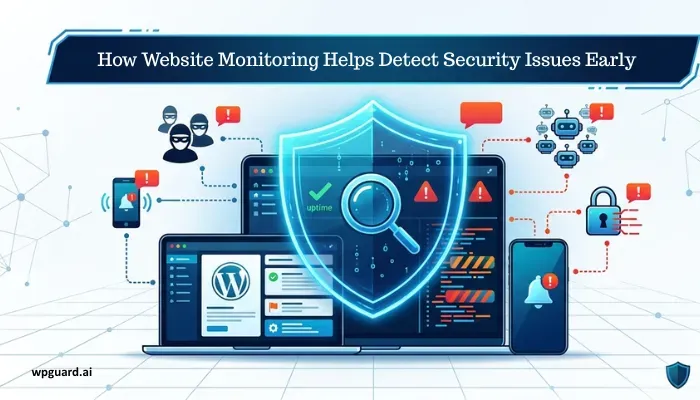
Website monitoring helps detect security issues early by tracking your site’s behavior and sending alerts the moment something goes wrong. However, most site owners don’t think about this until something has already caused damage.
Unfortunately, many WordPress site owners first learn about a breach when a visitor reports a problem, Google displays a safety warning, or the entire website goes offline. At WP Guard, we’ve seen this pattern appear repeatedly.
The good news is that you can easily stay ahead of these threats. In this guide, you’ll learn how surveillance works, what security risks to watch for, and how to set up the right protection for your site.
Website Monitoring and Security Threats: What You Need to Know
Most site owners don’t realise how many safety threats hide behind a normal-looking website activity. In fact, your domain could be serving malicious code to visitors while your analytics still look perfectly fine. That false sense of normality often gives attackers more time to steal data or infect additional pages.
The following two things explain why this happens:
What Website Monitoring Actually Tracks
Website monitoring automatically tracks your site’s uptime, speed, and behavior continuously. It also flags unusual activity like unexpected traffic spikes, file changes, or failed login attempts across your web pages.
Beyond just monitoring, a good surveillance setup scans your plugins, database, and core files for unexpected changes, malware, and other signs of tampering. So if unauthorized access happens without your knowledge, the system sends an alert straight to your team before anyone touches the data.
The Security Threats Most Site Owners Miss
Many site owners overlook slow-burning cyber threats like malware injections and potential vulnerabilities hiding inside outdated code. After reviewing dozens of compromised WordPress sites, we’ve seen that phishing pages planted by attackers on trusted domains are the last things owners find.
On top of that, credential stuffing attacks are just as easy to miss. In practice, hackers run automated login attempts against thousands of user accounts using leaked password lists. As each login attempt looks legitimate on its own, you rarely notice unusual activity until attackers gain access to multiple accounts.
Web Pages Under Attack: How DDoS Attacks Slip Past Unmonitored Sites
Website monitoring plays a major role in limiting the impact of a Distributed Denial of Service (DDoS) attack. That said, the sooner unusual traffic appears, the quicker you can investigate and respond before legitimate visitors lose access to your website.

These are three ways DDoS attacks slip past sites with no active surveillance in place:
- Floods Your Server with Fake Traffic: DDoS attacks hit your web pages with waves of malicious traffic, which push the server past its limit until it collapses. And owners only realize the network is under pressure when visitors start reporting errors.
- Looks Identical to a Traffic Spike: Without monitoring, automated bots blend into your regular visitor data by making your site vulnerable. Specifically, hackers target these sites because site owners often spot the attack hours after it begins.
- Leaves Your Site Down for Hours: Unchecked sites take far longer to recover because no alert fires when the platform goes down. So by the time your team investigates, the attack has already overwhelmed the server, and users are long gone.
A reliable vulnerability tracking setup changes this entirely. The moment unusual traffic patterns appear, your team receives an alert and can investigate before attackers cause further damage.
Web Application Firewall (WAF) vs. Website Monitoring: Do You Need Both?
Yes, you need both because a WAF blocks incoming threats, while website monitoring detects suspicious activity that gets past your first line of defence.
Many site owners assume a WAF protects them from every threat, but that’s only part of the picture. A quick breakdown of what each one does for your site:
| Feature | Web Application Firewall | Website Monitoring |
| Blocks malicious requests | ✓ | ✗ |
| Tracks behavior after access | ✗ | ✓ |
| Protects the database from SQL injection | ✓ | ✗ |
| Flags visual changes on the site | ✗ | ✓ |
| Monitors SSL certificates | ✗ | ✓ |
| Enforces strong passwords and two-factor authentication | ✓ | ✗ |
| Scans for potential vulnerabilities | ✗ | ✓ |
| Maintains compliance standards | ✓ | ✓ |
Simply put, a WAF examines incoming website traffic before it reaches your server. It blocks suspicious logins, filters harmful requests, and protects your database from attacks like SQL injection. Security plugins can add another layer of protection, but they don’t replace a dedicated firewall.
And monitoring takes over once traffic reaches your website. It watches for unexpected changes, checks SSL certificates, and flags activity that falls outside your normal patterns or backup schedule.
Verdict: Running both gives your platform the kind of layered defense that solo solutions simply can’t match.
How to Start Monitoring: Monitor Types and What Each One Does
Website monitoring tools don’t all track the same things. Some focus on uptime, while others watch for performance issues or safety threats. So start checking your site by picking a tool that covers uptime, performance, and security scans all in one place.
There are three types every WordPress site owner should know before the setup process begins.
- Uptime Monitoring: With this, you can check for live status and reachability every few minutes.
- Performance Monitoring: It tracks page load speed and server response time, which directly improve SEO since search engines factor loading speed into rankings.
- Security Monitoring: Scans for malware, blacklist status, and unauthorized visual changes to your pages.
We recommend running all three checks together, as each one fills a gap the others miss. This way, your site has full visibility into what’s happening at any given time.
Getting Your Whole Team on Board with Website Security
Shared monitoring dashboards keep your whole team updated on site health without relying on manual checks. Plus, automated notifications notify the site authority and cut response time when a real threat appears. Either way, clear role assignments are what separate a quick recovery from a messy one.
Based on our experience, teams that haven’t assigned surveillance roles almost always respond more slowly when an incident occurs. That’s why you must assign clear responsibilities for plugin updates, theme checks, WordPress core updates, and safety alerts. So everyone knows exactly what to do when a warning arrives.
Your Site Does Not Have to Be the Last to Know
Security issues generally show up in changed files, failed logins, and slow pages while you’re busy running your business. The sites that catch them early are the ones with active monitoring in place.
A solid defense combines a web application firewall with continuous tracking. Together, they protect your data, keep your platform secure, and make sure nothing slips past undetected.
Ready to stop finding out about problems after the damage is done? WP Guard helps WordPress site owners stay ahead of threats. We do it by implementing real-time alerts, automated scans, and a setup designed for teams who can’t afford downtime.